
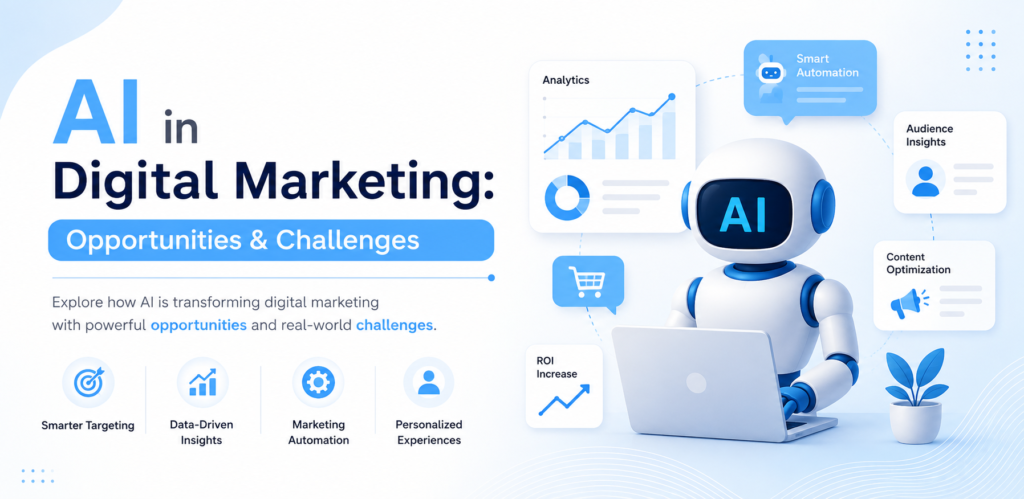
AI in Digital Marketing: Opportunities & Challenges
Artificial Intelligence (AI) is transforming the digital marketing landscape by helping businesses automate processes, improve customer experiences, and make data-driven decisions. From personalized recommendations to predictive analytics, AI is enabling marketers to reach the right audience with the right message at the right time. However, while AI offers tremendous opportunities, it also presents challenges that businesses must address to ensure sustainable growth.
Introduction
Digital marketing has evolved significantly over the past decade. Traditional marketing strategies have given way to data-driven campaigns powered by AI technologies. Businesses of all sizes are leveraging AI to optimize advertising, improve customer engagement, and enhance operational efficiency.
As AI continues to evolve, marketers need to understand both its advantages and limitations to maximize its potential.
What is AI in Digital Marketing?
Artificial Intelligence in digital marketing refers to the use of machine learning, natural language processing (NLP), predictive analytics, and automation tools to analyze customer behavior, create personalized experiences, and improve marketing performance.
Common AI applications include:
- Chatbots and virtual assistants
- Content generation
- Email marketing automation
- Predictive analytics
- Customer segmentation
- Search engine optimization (SEO)
- Social media management
- Personalized product recommendations
- AI-powered advertising
Opportunities of AI in Digital Marketing
1. Personalized Customer Experience
AI analyzes user behavior, browsing history, purchase patterns, and preferences to deliver personalized content and product recommendations.
Benefits:
- Higher engagement
- Improved customer satisfaction
- Increased conversion rates
- Better customer retention
2. Marketing Automation
AI automates repetitive marketing tasks such as:
- Email campaigns
- Lead nurturing
- Social media scheduling
- Customer support
- Ad optimization
This allows marketers to focus on strategy and creativity.
3. Improved Customer Insights
AI processes massive amounts of customer data in real time to identify trends and predict future behavior.
Businesses can:
- Understand customer preferences
- Identify buying patterns
- Improve campaign performance
- Make informed business decisions
4. Smarter Advertising
AI optimizes digital advertising by automatically adjusting:
- Target audience
- Budget allocation
- Bid strategies
- Ad placement
- Creative performance
Platforms like Google Ads and Meta Ads use AI to improve campaign results.
5. Enhanced SEO Strategies
AI-powered SEO tools help marketers:
- Find relevant keywords
- Analyze competitors
- Optimize website content
- Improve search rankings
- Identify content gaps
AI also helps create SEO-friendly content faster than traditional methods.
6. AI Chatbots and Customer Support
Modern chatbots provide:
- 24/7 customer support
- Instant responses
- Product recommendations
- Lead qualification
- Appointment scheduling
This improves customer satisfaction while reducing operational costs.
7. Predictive Analytics
AI predicts future customer actions based on historical data.
Businesses can forecast:
- Customer purchases
- Sales trends
- Campaign performance
- Customer churn
- Inventory requirements
8. Content Creation
Generative AI tools assist marketers in creating:
- Blog articles
- Product descriptions
- Social media posts
- Email campaigns
- Video scripts
- Ad copy
While AI speeds up content production, human editing remains essential for quality and originality.
Challenges of AI in Digital Marketing
1. Data Privacy Concerns
AI depends heavily on customer data.
Businesses must comply with privacy regulations and protect customer information to maintain trust.
2. Lack of Human Creativity
Although AI can generate content quickly, it cannot fully replicate:
- Human emotions
- Storytelling
- Creativity
- Brand personality
Successful marketing still requires human expertise.
3. High Initial Investment
Implementing AI solutions often involves costs for:
- Software
- Training
- Integration
- Maintenance
Small businesses may face budget constraints.
4. Data Quality Issues
AI performs only as well as the data it receives.
Poor-quality or outdated data can result in:
- Inaccurate predictions
- Ineffective campaigns
- Misleading customer insights
5. Ethical Concerns
AI can unintentionally introduce bias in:
- Advertising
- Customer targeting
- Hiring
- Recommendation systems
Businesses should regularly audit AI systems to ensure fairness and transparency.
6. Skill Gap
Many organizations struggle to find professionals with expertise in:
- AI technologies
- Data analytics
- Machine learning
- Marketing automation
Continuous learning and employee training are essential.
7. Overdependence on Automation
Excessive reliance on AI can make marketing feel impersonal.
Customers still value authentic communication, empathy, and human interaction.
Best Practices for Using AI in Digital Marketing
To maximize the benefits of AI:
- Combine AI with human creativity.
- Prioritize customer privacy and data security.
- Use high-quality, accurate data.
- Monitor AI performance regularly.
- Be transparent about AI usage.
- Train marketing teams on AI tools.
- Continuously test and optimize campaigns.
Future of AI in Digital Marketing
The future of AI in digital marketing is promising. Emerging technologies such as generative AI, voice search optimization, predictive customer analytics, and hyper-personalization will continue to reshape how brands interact with customers.
Businesses that embrace AI responsibly will gain a competitive advantage by delivering faster, smarter, and more personalized customer experiences while maintaining trust and authenticity.
Conclusion
Artificial Intelligence is revolutionizing digital marketing by enabling businesses to automate processes, personalize customer experiences, and make data-driven decisions. While AI offers numerous opportunities—including improved efficiency, smarter advertising, predictive analytics, and enhanced customer engagement—it also presents challenges related to privacy, ethics, implementation costs, and the need for human creativity.
The most successful marketing strategies will combine AI’s speed and analytical power with human insight, creativity, and ethical decision-making. By adopting AI thoughtfully and responsibly, businesses can unlock new growth opportunities and build stronger relationships with their customers.